
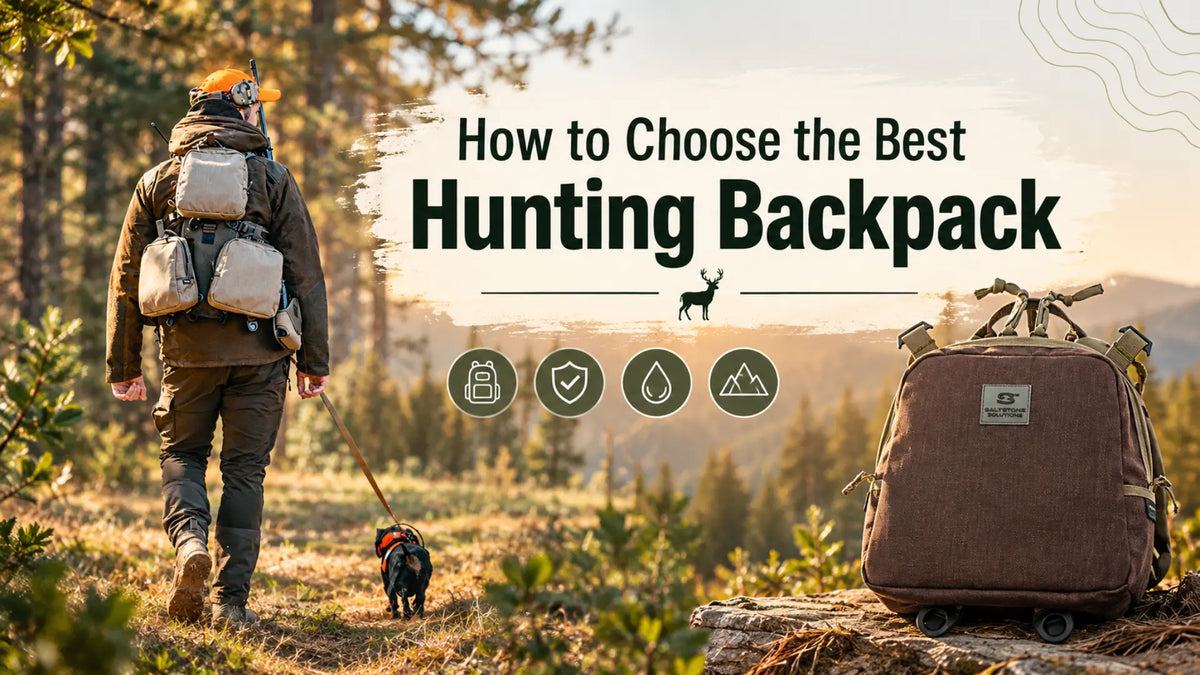
Whether you are packing into the backcountry for a multi-day elk hunt, stalking whitetails through thick brush, or setting up in a waterfowl blind, your gear transportation system makes or breaks your experience in the field. Carrying essential survival gear, optical setups, ammunition, water, and meat back to camp requires a haul system built to withstand harsh conditions.
Selecting the right Hunting Backpack isn't just about picking a pack with enough storage capacity. It requires an understanding of load distribution, fabric durability, weather resistance, and tactical organization tailored specifically to your hunting style.
This guide breaks down every factor you need to evaluate before purchasing your next piece of hunting haulage.
1. Frame Types and Capacity: Matching Your Pack to the Mission
The first step in choosing a hunting bag is determining how much gear you need to pack and how far you plan to carry it. Hunting packs generally fall into three distinct load-capacity categories:
Daypacks (1,000 to 2,500 Cubic Inches)
Designed for single-day excursions where you return to camp or your vehicle every night. These packs carry essentials: water, snacks, extra layers, game processing kits, and minor optics. They prioritize lightweight mobility over heavy weight-bearing capabilities.
Mid-Sized Packs (2,500 to 4,000 Cubic Inches)
Ideal for overnight stays or late-season day hunts requiring bulky cold-weather clothing and extra gear. These packs usually feature internal frames or semi-rigid stay systems that allow you to carry heavier loads comfortably without sacrificing agility.
Expedition / Backcountry Packs (4,000+ Cubic Inches)
Built for multi-day wilderness hunts where you carry your entire campsite, food supplies, and have the structural capacity to haul out heavy loads of quartered meat.
When selecting frame style:
-
Internal Frame Packs: Offer a streamlined profile that sits close to your body, ideal for agility, silent glassing, and crawling through dense timber.
-
External Frame Packs: Superior for carrying extreme weights (70+ lbs) like heavy big-game meat, keeping the load anchored directly to your hips and off your shoulders.
2. Weatherproofing: Why You Need a Waterproof Hunting Backpack
Weather in the backcountry changes in minutes. A sudden downpour, heavy snowfall, or crossing high-mountain streams can soak your spare insulation, electronic rangefinders, and medical kits if your gear lacks proper protection.
Investing in a high-grade Waterproof Hunting Backpack keeps critical survival equipment dry and functional. Pay attention to materials and construction details:
-
Cordura® Nylon: Military-grade woven nylon fabric offers tear resistance against sharp rocks, briars, and heavy brush while maintaining extreme water-resistant properties when treated with DWR coatings.
-
Taped Seams and Waterproof Zippers: Standard zippers allow moisture to seep directly into main compartments. Look for polyurethane-coated YKK® water-resistant zippers and taped seams to block liquid entry.
-
Hydrophobic Coatings: High-end tactical packs feature interior polyurethane backings that keep water from penetrating the fabric weave during continuous rainfall.
When you need rapid access to essentials without sacrificing weather resilience, a specialized modular pack—such as the 5L Waterproof Tactical Cordura Hunting Backpack—provides a lightweight, weather-tight solution for field survival gear.
3. Ergonomics and Load Distribution
A poorly fitting pack leads to premature muscle fatigue, shoulder strain, and painful chafing long before your hunt ends. Proper load carriage shifts up to 80% of the weight off your shoulders and onto your skeletal structure via your hips.
Key Ergonomic Features to Inspect:
-
Adjustable Torso Length: Your torso length (measured from your C7 vertebra down to your iliac crest) must match the pack frame. Fixed-length packs rarely fit every hunter correctly.
-
Heavy-Duty Lumbar Support & Waist Belt: Look for dual-density foam padding that molds to your hips without bottoming out under heavy loads.
-
Load Lifter Straps: Positioned above the shoulder straps at a 45-degree angle, these straps pull the top of the pack closer to your spine, preventing backward tilt and reducing shoulder strain.
-
Sternum Strap: Keeps shoulder harnesses anchored across your chest, ensuring arm mobility when drawing a bow or mounting a rifle.
4. Rapid-Access & Chest Systems: The Role of a Hunting Chest Pack
While a full-sized hunting backpack stores your heavy gear, taking your pack off every time you need your optics, rangefinder, wind checker, or sidearm wastes precious seconds and creates unnecessary noise.
Integrating a specialized Hunting Chest Pack into your kit keeps critical tools at chest height for immediate, silent access while keeping your hands free.
+-------------------------------------------------------------------------+
|                       THE DUAL-PACK SETUP SYSTEM                        |
+-------------------------------------------------------------------------+
|  HUNTING CHEST PACK                 MAIN HUNTING BACKPACK               |
|  - Binoculars & Rangefinder         - Heavy Meat Loads & Game Bags      |
|  - GPS / Mobile Mapping             - Extra Cold-Weather Clothing       |
|  - Wind Checker & Calls             - Water Bladder / Camp Supplies     |
|  - Sidearm & Vital Ammo             - First Aid & Emergency Bivy        |
+-------------------------------------------------------------------------+
Chest packs fit comfortably under your main backpack straps, creating a balanced distribution system that keeps your most valuable electronics protected from dirt, mud, and rain.
5. Stealth and Material Quietness
A pack can have all the features in the world, but if the fabric swishes loudly every time a branch rubs against it, it will spook game before you ever get in range.
For archery hunters or thick-cover stalkers, quietness is non-negotiable. Look for brushed micro-fleece, soft-shell exteriors, or specialized Cordura weaves designed specifically to dampen friction noise. Test zipper pulls as well—metal-on-metal zipper pulls should be replaced with paracord extensions to prevent metallic clinking in the quiet woods.
Summary Checklist for Choosing Your Hunting Backpack
Before making your final selection on SALTSTONE Hunting Gear, run through this simple checklist:
-
Match capacity to trip length: Daypack (<2,500 cu in) vs. Expedition (4,000+ cu in).
-
Verify water resistance: Look for Cordura® construction, DWR treatments, and sealed zippers.
-
Test load-bearing fit: Ensure the waist belt sits directly over your hip bones and the torso length is fully adjustable.
-
Add modular quick-access gear: Pair your main pack with a dedicated chest pack for glassing and navigation tools.
-
Check fabric noise: Ensure external materials are brushed or noise-dampened for stealth.
Frequently Asked Questions
Q1. What capacity hunting backpack do I need for a day hunt?
For a single-day hunt, a pack with a capacity between 1,500 and 2,500 cubic inches (25L to 40L) is ideal. This provides sufficient room for extra layers, a hydration reservoir, optical gear, food, and basic game-processing tools without adding unnecessary weight.
Q2. Is a waterproof hunting backpack really necessary?
Yes. Rain covers can blow off or snag on branches in dense cover. A inherently waterproof or highly water-resistant pack made from treated Cordura or synthetic laminates ensures your dry layers, food, and electronics stay safe during unpredictable weather.
Q3. How should a hunting backpack fit?
The majority of the weight (approx. 70-80%) should rest on your hip bones via the waist belt, not on your shoulders. The shoulder straps should wrap smoothly around your collarbones without leaving gaps, and load-lifter straps should engage at a 45-degree angle to pull the weight toward your center of gravity.
Q4. What is the advantage of using a hunting chest pack with a backpack?
A chest pack allows you to store high-frequency gear—like binoculars, rangefinders, GPS devices, and call slips—right on your chest for rapid, silent access. It eliminates the need to stop and remove your heavy main backpack while keeping your optics protected against impact and elements.