
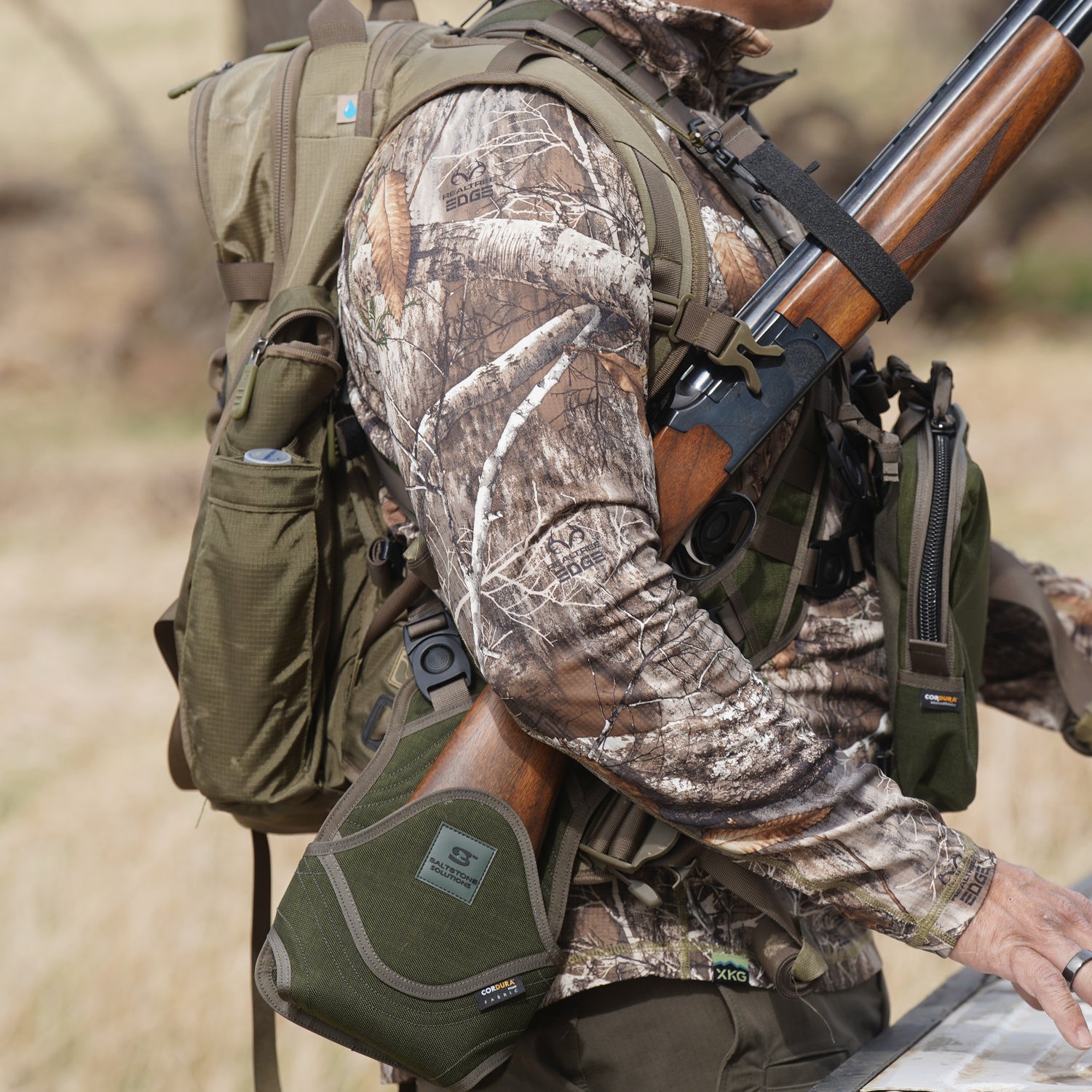
In real hunting conditions, the way you carry your gear affects how quickly you can move, react, and get to what you need.
A hunting vest is usually better for fast access to shells, calls, tools, GPS units, and other essentials. A hunting backpack is usually better for carrying heavier loads over longer distances. But for many hunters, the right answer is not always one or the other.
A modular hunting vest can bridge the gap by keeping critical gear accessible while adding storage when the hunt calls for it.
What Hunters Actually Need in the Field
Once you are moving through terrain, tracking, glassing, handling dogs, or reacting to changing conditions, three priorities matter most:
-
how fast you can react
-
how long you can stay comfortable
-
how efficiently you can carry what matters
The problem is that these priorities rarely line up perfectly.
A lighter setup helps you move quickly but limits what you can bring. A larger pack gives you more carrying power but often slows down access. That is why every hunter eventually has to match the carry system to the hunt.
Upland hunting, turkey hunting, dog tracking, big game day hunts, and multi-day backcountry trips all place different demands on your gear.
Hunting Vest: Built for Fast Access
A hunting vest is built around one core idea: important gear should be easy to reach while you are moving.
Instead of packing everything inside one main compartment, a vest keeps essentials in dedicated positions. Shells, calls, gloves, tools, dog gear, rangefinders, and small accessories can sit where your hands naturally expect them.
That matters most in fast-paced or reactive hunting situations.
When a bird flushes, a dog changes direction, a call needs to be grabbed, or a shot opportunity appears quickly, you do not want to stop and dig through a pack. You want your gear where you can reach it with minimal movement.
A vest works especially well for upland birds, small game, turkey hunting, driven hunts, and shorter day hunts where speed and access matter more than maximum storage.
The trade-off is capacity. A basic hunting vest is not meant to carry the same amount of gear as a full backpack.
Hunting Backpack: Built for Load and Distance
A hunting backpack has a different priority: carrying more gear over longer distances.
A well-designed hunting backpack, especially one with a frame or hip belt, can help carry heavier loads more comfortably. Backpacks also provide more room for extra clothing layers, food, water, optics, rain gear, survival equipment, and larger items.
That makes a backpack the better option for multi-day hunts, mountain hunts, remote terrain, cold-weather hunts, or any trip where you need more than the basics.
The trade-off is access.
Since most gear is packed inside, you often need to stop, remove the pack, open compartments, find what you need, and repack before moving again. That is fine when carrying capacity matters most. It is less ideal when you need fast access in the moment.
Hunting Vest vs Backpack: Side-by-Side Comparison
A hunting vest is best when you need:
-
fast access to shells, calls, tools, GPS, or small essentials
-
less bulk while moving through cover
-
a lighter setup for reactive hunting
-
gear positioned where your hands naturally reach
-
freedom to move without removing a pack
A hunting backpack is best when you need:
-
more storage capacity
-
extra layers, food, water, optics, or survival gear
-
better support for heavier loads
-
space for bulky items or longer trips
-
a setup for remote, demanding, or multi-day hunts
Neither system is automatically better. The right choice depends on the hunt, the terrain, the weather, and how much gear you actually need.
What If You Did Not Have to Choose?
Most hunters think of the vest vs backpack question as an either/or decision.
But many hunts call for both: fast access to critical gear and enough storage to stay out longer.
That is where the SALTSTONE INTEGRATOR fits in.
The INTEGRATOR is a modular hunting vest and rifle carry system built around hands-free carry, fast rifle access, and adaptable storage. Its patented 5-Point Load Balance Structure distributes rifle weight across the upper body instead of leaving it on one shoulder like a traditional sling.
That matters on long days in the field. Less shoulder strain means you can move more comfortably, keep both hands free, and stay ready when an opportunity appears.
The modular design also lets you build the system around the hunt.
Need compact storage? Add the 5L Pack. It can mount in six positions on the INTEGRATOR, including the chest, back, or sides.
Carrying shotgun shells? Add the Anti-Spill Ammo Pouch, which holds 30 pieces of 12 gauge ammo and allows quick one-hand access.
Hunting birds or small game? Add the Game Pouch for 12L / 732 cu of rear-mounted storage for pheasant, quail, rabbit, turkey, waterfowl, and other small game.
Need a Garmin dog tracking GPS in view? Add the chest-mounted Garmin MOLLE Mount for compatible Garmin handhelds with the SPINE MOUNT system.
Using a radio or tripod? Add the Radio Holster or Tripod Holster to keep those tools secured and accessible.
The point is not that the INTEGRATOR replaces every backpack. It is that it gives hunters a modular platform that can run light like a vest, carry more like a small pack system, and keep key gear organized around the way they actually hunt.
When a Backpack Still Wins
A modular hunting vest does not make backpacks obsolete.
If you are packing camp gear, carrying bulky winter layers, hauling meat, or going deep into the backcountry for multiple days, a real hunting backpack is still the better tool.
But you do not always have to choose one system and leave the other behind.
The INTEGRATOR can be worn with an existing backpack. Put the INTEGRATOR on first, then wear the backpack over it. That way, you keep the benefits of hands-free rifle carry and fast access to essential gear while still using a backpack for larger loads.
For many hunters, that combination is more practical than trying to force one setup to do everything.
The Right Setup Starts With Adaptability
There is no perfect carry system for every hunt, but there is a better way to build around changing field conditions.
A traditional hunting vest gives you fast access, but it can be limited when you need more storage or better rifle carry. A full hunting backpack gives you capacity, but it often slows down access to the gear you need in the moment.
The SALTSTONE INTEGRATOR is built for the space between those two systems. It gives hunters fast access to essential gear, hands-free rifle carry, balanced weight distribution, and the ability to add storage when the hunt demands it.
And when a full backpack is still needed, the INTEGRATOR does not have to be left behind. It can be worn with an existing backpack, giving you rifle carry and quick-access organization while the pack handles larger loads.
Explore the full SALTSTONE modular system to see how the INTEGRATOR and add-ons fit together.
FAQ
What is the main difference between a hunting vest and a backpack?
A hunting vest prioritizes fast access to essential gear while you are moving. A backpack prioritizes carrying capacity and heavier load support over longer distances. Vests are better for reactive hunts, while backpacks are better for longer trips or heavier gear loads.
Is a hunting vest better than a backpack?
It depends on the hunt, but for many mobile day hunts, a modular hunting vest system can be the more practical setup. A basic vest gives quick access to shells, calls, GPS, tools, or dog gear, while a backpack gives more storage for extra layers, food, water, or optics. The SALTSTONE INTEGRATOR bridges that gap by combining fast access, hands-free rifle carry, balanced weight distribution, and expandable storage.
Can you use a hunting vest and backpack together?
Yes. Many hunters use both depending on the hunt. The SALTSTONE INTEGRATOR can be worn with an existing backpack by putting the INTEGRATOR on first and the backpack over it. This lets you keep the rifle carry and quick-access benefits of the vest while using a backpack for larger storage.
Which is better for long-distance hunts: vest or backpack?
For long-distance hunts with heavy gear, a backpack usually wins. For long day hunts where fast access and rifle carry comfort matter, a modular vest like the INTEGRATOR can be useful. For some hunts, combining both is the best setup.
What should I look for in a hunting vest?
Look for comfortable weight distribution, easy access to frequently used gear, low bulk, durable construction, adjustable sizing, and modular attachment options. A good hunting vest should support movement instead of getting in the way.
Is a modular hunting vest system worth it?
Yes, a modular hunting vest system is worth it if your hunting setup changes by season, terrain, or hunting style. The SALTSTONE INTEGRATOR lets you run light when speed matters, add storage when you need more capacity, and carry a rifle hands-free with balanced weight distribution. That makes it more adaptable than a basic hunting vest and more accessible than relying only on a backpack.